Advising is a difficult job

April 28th, 2007

One of the many hats I wear here at the college is that of student adviser. On the surface, it seems a simple task; look at the student’s courses and make sure they stay on track for their major. But it’s less easy than it looks.

A colleague of mine was advising a student recently. I overheard, since all of the science department offices are clustered right next to one another. This student had declared nursing as a major, and had just finished our remedial English and math courses – making him ready to move on to introductory algebra and freshman composition and some freshman-level college courses.

To qualify for admission into the nursing program***, however, this student still needs to take a four semester sequence of introductory anatomy, college anatomy, physiology, and microbiology. There’s a small wrinkle; he’s attempted the introductory anatomy course one time already and had to drop because he wasn’t doing well. One more poor grade would drop him into academic probation.

So, this student is looking at no fewer that eight semesters until he can graduate with an associate’s degree in nursing and become an R.N. It’s going to be a long road for this student. For many in similar situations, it is an impossible road. Most students who drop out of our simplest anatomy course for academic reasons do not make it into the nursing program, and fewer still actually make it through.

Still, though, everyone deserves their shot. This is one of the students that you put into his courses, warn him that his performance in these introductory courses will determine if he gets into nursing or not, and suggest that there are other programs – like surgical technology**** – that he could get into and land a hospital job in year or so. And if he’s still gung-ho on nursing, you point out places – like the tutoring center – that will increase his chances of making it through his upcoming science classes.

So, my colleague starts figuring out what courses this student needed, and the student drops his bombshell. He wasn’t really interested in being a nurse. He was going to go to medical school and be a doctor. The nursing degree, he said, was just something to do until he became a doctor.

My colleague, sounding a bit surprised by the student’s revelation, suggests that the student might want to change his major to one of our degrees meant for college transfer. Most of the courses required to get an associate’s in nursing are specific to the program – and not accepted for credit at a university. At this point that the student becomes defensive and accuses my colleague of “being negative”. Apparently, the student doesn’t want to hear that the path they’ve chosen might not be the best way to reach his goal.

So what can you do with a student like this? Not a lot, I’m afraid. It makes me sad. This student sees us as an adversary – an obstacle they must jump over to reach his goal. That view will hurt him every time he steps into a classroom, and may very well contribute to his goals remaining forever out of reach.


***Our school has an open-door policy. Essentially, anyone who wants to come out here can come. Individual programs do have entry requirements, though. Even so there are usually multiple ways to get into a program. For nursing, students who don’t score high enough on the SAT can earn their way into the program by completing their required biology and math courses. After they have proven themselves, they’ll be accepted to the program.

****Surgical technology doesn’t pay as well as nursing, but it requires only a single anatomy course. Students who can’t handle the anatomy and microbiology requirements for nursing can often succesd in this program.

Friday cat: Sunny side up!

April 27th, 2007

We seem to have gotten through our last cold snap down here in South Carolina, and the sun is just getting warmer and warmer. While we humans are pulling out fans and turning on air conditioners to cool off, our cats have an entirely different idea:

[Ash: Sunny side up!]
Ash: illustrating the feline way of dealing with the heat!


For more animal friends, be sure to visit The Friday Ark!

Friday Cate: Rare, black-footed Cate

April 27th, 2007

You know those cute little baby footprints you often see in a frame along with baby pictures? When you see those print-making kits in the store, they seem like an awfully easy thing to use. Just put your baby’s hand or foot on the stamp pad, then press the inked body part onto the paper.

Simple, right?

Cate thinks otherwise!

Break time! Demon Attack for the Atari 2600

April 26th, 2007

[Break Time! is a series of posts about video games that Rick has spent entirely too much time with over the years.]

If you’ve glanced at this series before, you’ll know that I’m a game collector, and have a decent library of Atari 2600 titles to choose from. Most of them aren’t worth pulling out in 2007, but there are still a few that still manage to be fun.

Demon Attack, by Imagic, is one of the fun ones.

[Demon Attack attract mode]
Demon Attack’s attract mode***

The premise of Demon Attack is pretty simple. You control a ship at the bottom of the screen, and your mission is to shoot wave after wave of flying “demons”. The demons? Well, their mission is to destroy you by any means possible.

Part of the fun of Demon Attack is that the game is very simple to play – yet there’s a bit of variety. As is the case in almost all of these games, the aliens get faster as the game progresses. Demon Attack also varies the aliens and their tactics a bit.

First, the aliens change their appearance and how they shoot at you – varying between beams and small clusters of bullets (the small clusters seem a little easier to dodge).

[Demon Attack aliens]
Another variety of aliens

The first few waves of aliens simply die when you blast them. Later on, each alien will split into two smaller ones.

[Demon Attack aliens … these split!]
Still more aliens. These aliens split into pairs of smaller ones when you shoot them!

These smaller aliens are not just hard to hit. They have an entirely new tactic. If you shoot one member of the pair, the other member dives at your ship. In later waves, dodging these little guys becomes extremely difficult.

[Demon Attack’s kamikaze aliens]
If you shoot one of the pair, the other one tries to dive into your ship!

Like Dark Cavern, Demon Attack is surprisingly intense – and a nice test of your reflexes. It is simple, fast, and fun – well worth looking at if you have an old Atari 2600 or an emulator around.


***An arcade-like attract mode is somewhat uncommon for Atari 2600 games. Often, game coders didn’t bother with them on the machine, or would show a nearly static screen with cycling colors!

Target: Homeopathy

April 25th, 2007

Long-time readers of this blog – all three of you – know that I am no fan of homeopathy. I am, though, something of a fan of Target . This is largely due to the fact that Target’s only local competition is Wal-Mart. The shopping experience at Wal-Mart is only slightly less pleasant that being repeatedly hit on the head with a baseball bat. But I digress…

We were making our usual Target run the other day. This time, though, Patty was suffering from an earache. So, while I sifted through the clearance merchandise, Patty asked the pharmacist to suggest something to ease the earache pain.

The pharmacist recommended the Target-brand generic version of this Similisan product. So, Patty put it in the cart, we bought it, and we took it home. Here’s the front of the package:

Target’s homeopathic ear drops (front of package)

Looks like normal medicine, right? A little later into the evening, Patty told me that the ear drops from Target didn’t work very well – not nearly as well as the drops she had gotten from the doctor the last time she had an earache. So, we looked at the label again to see what sort of things were in the drops. Here’s what the back of the label looked like.

Target’s homeopathic ear drops (back of package)

The first thing that caught my eye was the list of ingredients.

  • Chamomilla HPUS 10X (calmative, pain reliever).
  • Mercurius sol. HPUS 15X (anti-inflammatory).
  • Sulphur HPUS 12X (pain reliever, anti-itch)

That’s an odd list of ingredients, isn’t it? it soon hit me that the Target pharmacist had just sold us an expensive bottle of quackery: homeopathic ear drops. Here’s the list of ingredients in plain English.

“10X”, “15X”, and “12X” are homeopathic dilutions. Suffice it to say that there’s very little of these ingredients in the drops. Considering the toxicity of mercury, that’s a very good thing.

I admit that I don’t make a habit of scouring the over-the-counter drug aisles looking for quackery, but I was surprised that this normal looking bottle of “medicine” was being sold at Target. I’m highly disappointed in Target and its pharmacist for ripping us off, and I was tempted to take my business elsewhere. However, I checked several other stores and pharmacies and they all carry either the Similisan product or their own generic version. Unfortunately, I can’t single out Target for pushing nonsense. Everyone’s doing it.


Let me add a few things here about homeopathic drugs. As I pointed out in my earlier post, there’s practically no theoretical (or experimental) support for homeopathy. In addition, homeopathic drugs don’t undergo the efficacy testing or several parts of the safety testing that conventional drugs do. Manufacturers of homeopathic drugs don’t have to prove their drug works, nor do they have to “release test” the final product (test it to make sure it is what the label says it is) before distribution.

What a racket!

Stop, thief!

April 24th, 2007

My bandwidth usage has spiked over the past couple of weeks. Has my little corner of the web suddenly gotten really popular?

I can dream, can’t it? 🙂

What’s going on is that some sites have started to hotlink my images. To hotlink an image is to use an <IMG> tag to make an image on another site appear on your site, while actually loading the image from the other site. It’s bad for two reasons:

  1. It doesn’t give the original site/author credit for the image.
  2. The original site/author actually has to pay for the bandwidth used by the image every time someone looks at the hotlinking site.

So, who’s stealing?

Here’s a small time thief at LiveJournal. Not such a big deal, since this thief’s page doesn’t get very many hits.

Here’s a much more annoying thief: Free Republic.*** They’re more annoying because they suck up much more bandwidth than the small-timer from LiveJournal, and because all of this bandwidth is sucked from my site in the name of right-wing back-slapping over Sean Hannity’s radio show.

The biggest offenders by far, though, are myspace.com and offtopic.com. If you’re visiting from those places, please enjoy this site … but stop hotlinking my images! If you want to show someone else something from my site, then just link to the page where the image is, ‘kay? Thanks.

Because of all the hotlinking, I’ve had to modify the site a bit. A link directly to one of my images will show this:

nohotlinking.jpg

(If all the images on this site look like that, then there might be a problem with your web browser’s security settings. Let me know if you’re having trouble with the images on the site and I’ll try to help.)


***Just think of what sort of image I could have put up on that Free Republic thread! 🙂

Break time! Star Ocean: The Second Story for the Playstation

April 23rd, 2007

[Break Time! is a series of posts about video games that Rick has spent entirely too much time with over the years.]

I’m a game collector. It’s not rare for me to have multiple copies of the same game in my collection, since I often buy games in large lots along with other games. It is rare for me to buy two copies of a new game, though. Star Ocean 2: The Second Story is the only game I have ever bought twice – while it was still a new game.

Why did I buy the game twice? The short answer is that my copy got damaged to the point that it wouldn’t play anymore. Here’s the long answer.

Star Ocean: The Second Story (which I’ll call SO2 from now on) is a Japanese-style role playing game for the original Playstation.

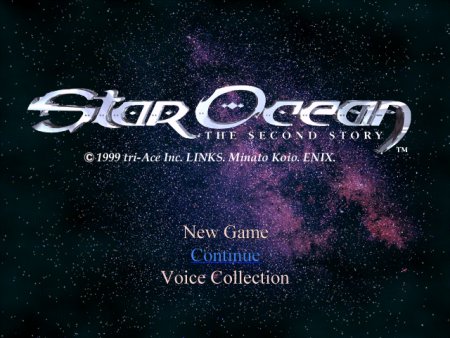
Star Ocean 2 Title Screen
Title screen

SO2 boasts some unique gameplay elements (for its time). First, there’s the combat system.

In the twentieth century, most Japanese-style role playing games had what I’ll call a “whack-a-mole” combat system.*** Your party would stand on one side of a battlefield, while your enemy would line up on the other. You and the enemy would take turns attacking each other. Sometimes, the only actions you could take would be to choose what enemy to attack, or use an item or magic spell. Some of these combat systems made your position on the field important, and some didn’t. But these systems, by and large, had one thing in common – extremely tedious combat. There’s only so many times you can mindlessly select “attack” from a menu before you want to throw the controller down onto the floor and stomp on it. Add to this the fact that battles could occur randomly and frequently, and these games could get rather frustrating.

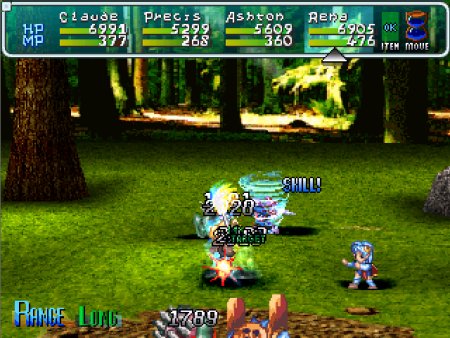
SO2, though, features a real-time combat system. You control one of your four combatants, while the computer controls the other three. You’re free to run around the battlefield and attack enemies. You can evade many attacks by … moving out of the way. You can surround an enemy and beat him to a pulp. (But they can do the same to you, so you have to be careful!)

Star Ocean 2: Combat (#1)
Combat

Combat is fast and furious. Characters have many special moves, which you use much like the moves in a fighting game. Battles are usually fairly short, and there’s always something going on.

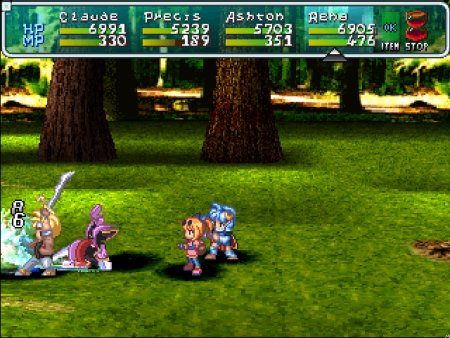
Star Ocean 2: Combat (#2)
Combat

If your characters are strong enough, you can sometimes sit back and watch the computer kick enemy butt. (This is good for random battles with weak enemies.)

In short, combat in SO2 is actually entertaining, which means that the battles necessary to progress through the game’s storyline don’t seem like a chore.

Speaking of the story, that’s another area where SO2 tries some new things. For one, there are two main characters. You choose your main character at the beginning of the game, and the story is told from that character’s perspective. The events in the story are often similar for both characters, since the two meet each other within the first hour of play. Your choice of main character, though, dictates how you’ll see the story unfold. Some events will only be seen by one of the characters, and some secondary characters will join you only if you’re playing the right main character.

You will see many of the usual Japanese-style RPG cliches. There’s a young girl with a mysterious past and strange powers, a world to save, etc. – but SO2 keeps it entertaining.

You can also influence the outcome of the story. SO2 has about eighty or so different endings (you get more than one “ending” per game – each of your party members gets one) – which depend on your actions in the game. Most Japanese-style RPGs have a single ending. You either get “the ending” at the end of the game, or you die in battle somewhere and get a “game over” screen. But SO2 allows you to interact with your party members. What you say to them (or do to them) influences how much they like you, and will change their fate at the end of the game. You can even pair characters up at the end of the game if you like. How? Mainly through something called “Private actions”:

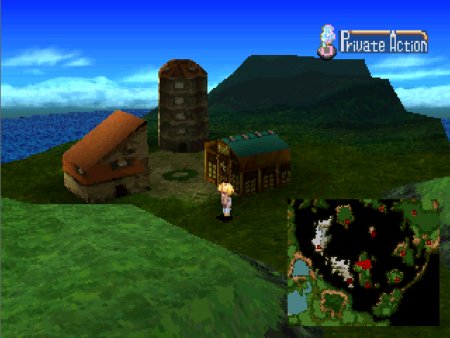
Star Ocean 2: Private Action (#1)
Private actions

When you enter a town, you usually have the option for your party members to enter either as a group or individually. Entering the town individually starts a “private action”, and you can go find your characters in the town and talk to them.

Star Ocean 2: Private Action (#2)
Private actions

Your choices in these conversations – or your actions in the little quests they may want you to go on – cause characters to like you more or less. There are even characters that may join your party (or not) as a result of these private actions. This adds a lot of variety to the game.

There are mini games (a bunny race, a combat arena, an “Iron Chef” cooking competition) and side quests to keep you entertained as well. You can build custom weapons and armor using items you find or buy. You can customize your characters by buying all sorts of “skills”. You can write novels to earn money or influence how much characters like each other. You can even make your character into a pickpocket who can steal items from the people you meet in your travels. Just don’t steal in front of (or from) your other characters, or they’ll start to dislike you! There’s also a huge bonus dungeon for those who want even more challenge. You won’t be hurting for something to do in this game!

The game isn’t quite flawless, though. The English translation leaves a little to be desired. There are random battles, so it’s sometimes difficult to explore areas without getting disoriented by combat. Plus, the game crashes occasionally in the last dungeon (so make sure to save your game!)

Even with those flaws, Star Ocean: The Second Story is an excellent game. And it’s one I’ve probably spent far too much time on over the years.


***Sadly, this trend of boring, annoying combat systems has continued into the twenty-first century. I’m looking at you, Xenosaga!

Friday cat food: Rowdy gulls

April 20th, 2007

These gulls are a rowdy lot. They need a head bird to whip them into shape!

[Rowdy gulls]

That gull in the middle is keeping the rest in line: Now flock and give me twenty!

[Click this link for a larger version – 1024px]


Find more animal friends on the Friday Ark!

Friday Cate: Beach baby!

April 20th, 2007

What’s this?

Cate’s first “steps” on the beach (450px)

This is a picture of Cate’s first “steps” onto the sand at Myrtle Beach!

Cate rolling on the beack (450px)

Cate’s not quite ready to crawl around in the sand. But she does want to roll in it!

Spurrier picks a fight …

April 18th, 2007

I’ve not had much time for local news the past few days, but I notice this morning that Steve Spurrier (head football coach at the University of South Carolina – for those of you who don’t follow South Carolina’s dominant religion) has blasted the flying of the Confederate flag on State House ground.

Spurrier feels that

“No one had ever asked me about my opinion on the flag, but if they had I would have told them it needs to come down. I don’t know anybody that disagrees with me, but obviously there are a lot of South Carolinians that do.”

[…]

The flag issue, according to Spurrier, is an obstacle to the state’s improving its image.

Sounds pretty sensible to this Tiger fan. If you want to convince the rest of the country that South Carolina isn’t a state full of ignorant, bigoted rednecks, a good place to start might be that flag and the racism it has come to symbolize.

I actually learned about Spurrier’s remarks from taking a glance as the letters to the editor page of The State. One letter caught my eye. It said:

Coach Steve Spurrier’s claims that removing the Confederate memorial flag would “make us a more progressive, better state.” This is akin to a coach saying that if the team would change its uniform colors or mascot, the team would score more touchdowns.

[…]

Removing a flag that commemorates history to solve the state’s problems makes as much sense as rearranging the deck chairs on Titanic to save the ship.

In a sense, this letter writer has a point. Removing the flag would do little to ease the burdens of folks living in our poorest counties. It would do little to improve infant mortality, or to better fund our schools.

But I’ve learned something from being an educator all these years. For a student to rise to the challenge of learning something new, he must first realize that his ignorance is not something to be proud of. Once he realizes that, he has a motivation to invest the time and effort necessary to learn something new.

For this state to become a “more progressive, better state”, it has to do the same thing. We have to stop being proud of the ignorant things some of our forefathers did. The flag is just a small step, but it’s an important one.

The letter writer got his metaphor wrong. Removing the flag isn’t rearranging the deck chairs. It’s taking the first, small step towards the lifeboats.