About Virginia Tech …

April 17th, 2007

The news yesterday was dominated – as you’d expect – by the Virginia Tech shootings. News sources provided continuous “coverage”. They speculated endlessly about the causes of the shooting and the motivations of the shooter. As I arrived home yesterday, CNN Headline News was running some woman who was convinced that the shooting was caused bythe “degeneration” of American culture and the prevalence of violent video games. Of course, no one yet knew a thing about the shooter except that he may have been “Asian”. Other news outlets were – more or less – doing the same thing.

Now we know that the shooter was a South Korean English major. So much for the whole “degeneration of American culture” argument. But I’m sure there will be equally pointless avenues of speculation available to today’s news shows.

As a college educator, I feel like I ought to say something about the whole affair. A day later, I’m still at a loss as to exactly what I should say. This was a terrible tragedy. More that thirty people were killed. What can I possibly say about that?

Was it preventable? At this point, it’s difficult to say. We don’t know why the shooter did what he did, or if there were any obvious signs that he was about to go on a rampage. And how do we protect students from someone who is determined to take his own life and as many others as he possibly can – while maintaining an environment where students can learn?

Could the school have handled the situation any better? Perhaps, but it’s entirely too easy to armchair-quarterback what the school “should” have done after the events have already happened. About all I can say on that matter is that I’m surprised the administration didn’t cancel classes after the first shooting. But … I work at a small school with no on-campus housing. At my school, canceling classes would have cleared nearly everyone from the campus. That’s not going to be the case at Virginia Tech.

I might have more to say on this later. Right now, I’m still … stunned.

Friday Cate: The future’s so bright

April 13th, 2007

Part of Cate’s first trip to Myrtle Beach involves shopping at the outlet stores. Before she can go shopping, though, she needs to be properly prepared.

Cate in shades (450px)

Now Cate’s ready for a shopping day in the sun!

Cat Cate

April 12th, 2007

There won’t be very many posts this week, since I currently have very limited internet access. But here’s something I thought I would share with y’all.

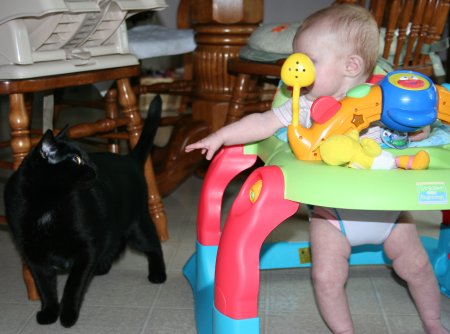
Cate has noticed the cats. She has seen the cats for a while now. Up until recently, though, she’s seen the cats as similar to things you’d see on a television screen. The cats were things to watch, but not things to touch and interact with.

Not any more!

catcate_450.jpg
Cate and Tom

Cate now reaches for and touches the cats. They are lucky that she hasn’t yet discovered that cats have tails!

South Carolina’s ultrasound bill

April 5th, 2007

Perhaps you’ve heard of South Carolina’s latest attempt to embarass itself? It’s called HR 3355, a bill which would add the following to South Carolina law.

Any woman who wants to have an abortion, for whatever reason would be forced to have and view an ultrasound of the fetus:

The obstetric ultrasound must be performed by the physician who is to perform the abortion or a certified technician working in conjunction with the physician.

The images viewed by the physician or certified technician to verify the gestational age must be reproduced and reviewed with the mother by the physician or allied health professional working in conjunction with the physician prior to the woman giving informed consent to having an abortion procedure performed.

[…]

The woman must certify in writing, before the abortion, that the information and obstetric ultrasound images […] have been provided to and reviewed with her

I discussed this bill with my wife the other day. She thinks it’s a boneheaded bill, and I agree. Why do we think this bill is bad?

  1. Our courts have already decided that a woman has a right to control her reproduction. This is just an attempt to add more onerous restrictions on that right.
  2. It’s a cheap scare tactic. Show a woman a picture of something that vaguely resembles a human with the intent of guilt-tripping her into not doing something that she has already made a decision to do.
  3. The state is forcing an unnecessary medical procedure on a woman, who will not benefit in any way from the procedure.
  4. To add injury to insult, the state will apparently force the woman to pay for the procedure. Unless I missed it, there is no mention of funding being provided for these mandatory ultrasounds.
  5. South Carolina already has a relatively low abortion rate. What problem are legislators trying to solve here – aside from the omni-present need to pander to a certain set of religious conservatives?
  6. Presumably, the intent of this bill is for women to give birth to more unwanted children. Given the fact that South Carolina does such a poor job with the children we do want, how can this possibly be a good thing? (South Carolina’s infant mortality rate is one of the highest in the nation.)

We here at Shrimp and Grits are not pleased that our legislators are wasting time with such foolishness.

Bachelor’s or bust?

April 5th, 2007

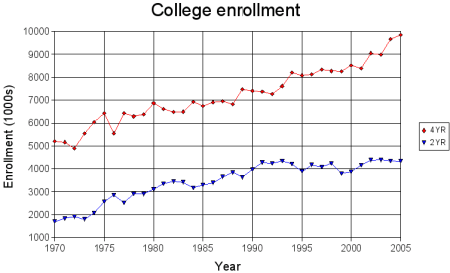
Take a look at this graph, showing college enrollment (in thousands of students) from the 1970s through 2005.


Source data: US Census Bureau

The red curve is what you probably expected. College enrollment increases fairly steadily with time. (The sharp dip in the late 70s is an artifact of changing the method of counting students).

But there’s a wrinkle. The red curve counts only undergraduates at four-year colleges. The blue curve shows the situation in America’s two-year colleges: community colleges, junior colleges, and technical colleges. Enrollment in our two-year colleges is flat, and has been so since the early 1990s. Before 1990, two-year college enrollment grew along with four-year enrollment.

Is the conventional wisdom that you need at least a bachelor’s degree to get any kind of worthwhile job now so entrenched that nobody thinks to go to a two-year school anymore?

Since I teach at a two-year school, the flat enrollment figures concern me. I worry that students who are perfectly capable of getting a two-year degree and a good job*** are being siphoned off by four-year schools – who then proceed to chew many of them up and spit them out without either a degree or useful job skills.

So, why are two-year college numbers so flat? Your thoughts?


***Who do you think has better job prospects? A new registered nurse with an associate’s degree in nursing, or someone who has just gotten their bachelor of arts in English?

Multiple choice tests

April 2nd, 2007

Students love multiple choice questions. I typically have several types of questions on my
chemistry tests. If I tell my students that there will be only, say, fifteen multiple choice questions on the upcoming test, I will almost always have several students frown and ask for more.

Sometimes, I’m tempted to give in and just give a multiple choice test like these students want. After all, multiple choice questions are the easiest kind of test question to grade, and I don’t have any assistants to grade papers for me.*** But I don’t give in. The reason? Because students almost always perform more poorly on multiple choice questions than they do on “harder” question types.

Why?

Some students will tell me that they like multiple choice questions because the right answer is already on the paper, and it’s easier to find the answer in a list than it is to figure the answer out. This might actually be part of the reason that students do so poorly on multiple choice tests: They don’t think that they have to figure anything out, and they expect multiple choice questions to be like this:

These charged particles are normally found inside the nucleus of atoms.
A) birds
B) cheeseburgers
C) oranges
D) orangutans
E) protons

… where the right answer is immediately obvious, even if you don’t know a darned thing about chemistry or the nuclear model of the atom. Instead, they get questions more like this:

These charged particles are normally found inside the nucleus of an atom.
A) borons
B) electrons
C) neutrons
D) photons
E) protons

This is still an easy question, but some students will miss it. These same students are able to draw a picture of and describe the basic details of the nuclear model of the atom in a later (not multiple choice) question on the same test! My conclusion is that the student misses the multiple choice question because he simply doesn’t expect to have to think about it.

I see the same thing with multiple choice questions that involve a calculation. If the same problem is presented as a multiple choice question and as a problem where they have to write their answer in a blank, the students will miss the multiple choice problem more often. They will try to do the multiple choice problem directly on their calculators (despite scratch paper being available), while they will usually write down the steps of the problem where they have to put their own answer in a blank.

In summary, if any students are reading this – don’t ask for more multiple choice questions! They’re not really “easier” than any other kind of question, and they’re more likely to bring your grade down!


***Well, except for this assistant. But you don’t want her grading your paper!

Friday Cat: Cat TARDIS

March 30th, 2007

It doesn’t look much like a police box, but Rusty has her own TARDIS.

Clearly, this blue basket is much larger on the inside than it appears on the outside!


Find more animal friends on the Friday Ark

Friday Cate: That’s my bear!

March 30th, 2007

I missed posting a picture of Cate last week, since we had our hands full with Cate’s first illness. (Not an ear infection, surprisingly enough!) She’s better now, and back to grabbing everything in sight.

This is her bear!

What homeschooling is about

March 30th, 2007

Ed Leap has an editorial on the Greenville News site called Homeschooling is about far more than education.

So, what does Ed think homeschooling is about? What are the advantages? Many things:

People educate their children at home for many reasons. For some, it is a way to cloister their families from the world. That seems, to our modern, connected, socially conscious society, like a backwards idea. And indeed, in rare instances, the children do not benefit, but develop an unfortunate paranoia, transmitted from worried parents. On the other hand, a few minutes with the news, a few hours looking at the statistics on drugs, crime and sex in our culture, and a little “cloistering” doesn’t seem so bad.

I’m getting suspicious here. This sort of reasoning usually leads to crazy fundie talk. Ed seems to be saying that because people have sex, it might not be a bad thing to lock your kids away from the outside world.

Ed then outlines some more advantages of homeschooling.

Scripture doesn’t conflict with learning; in fact, reading it can be a learning experience in itself, and a series of lessons in culture and history. There can’t be a concern over separation of church and state when the state isn’t involved.

That’d depend on how literally you read said Scripture. Read it too literally, and it can conflict with learning.

Furthermore, the homeschool family can ask pointed questions about controversies without being accused of being Cro-Magnons: “What are the weaknesses of arguments for and against evolution?” Or the more heinous, “Could it be that global warming isn’t a problem?” The scandal! It’s getting harder and harder to have divergent ideas about anything in our modern world of alleged diversity; except at home.

Usually, when someone uses the phrase arguments for and against evolution, he’s a creationist who wants to teach creationism. That’s simply because these “arguments against” are bunk. They are merely smoke used to cast doubt upon settled science that conflicts with a narrow interpretation of Scripture. Homeschooling, of course, gives the homeschooler the freedom to teach these bad arguments as if they were actually true. But I don’t really consider this an advantage.

Finally, Ed coughs up the crazy.

We like the fact that our children can start to learn the critical skills of rhetoric and argument, so that they aren’t one day ambushed by college professors who would happily bully away their deepest held beliefs.

Another advantage: the homeschooler is free to drill apologetics into their child’s head just in case she ever meets one of those evil, atheistic college professors. Did you know that those evil professors line up in front of the dorms to bully away the deeply held religious beliefs of new students as they arrive? it’s brutal, I tell you! Brutal!

Why is it that almost every time I see an opinion piece about homeschooling, it drifts off into fundie Bizarro world?

This might have something to do with it. 30% of homeschoolers cite religion as their primary motivation for homeschooling, and more than 70% cite religion as at least one of the reasons they homeschool.

I wonder if Ed’s merely one of the 70%, or one of the 30%…


For the record, I’m not actually opposed to homeschooling. I may not do it myself, or think that for most people it’s a very wise thing to do. I certainly do not think that anyone deserves a tax break for homeschooling. However, I think a parent has a right to educate their child as they see fit.

Blue side: Democratic candidates on health care

March 29th, 2007

Talking Points Memo’s Election Central has some information on the Democratic candidates views on fixing our broken health care system.

For Clinton, Obama, and Edwards – things appear about the same as I said in my last post on this topic. The Election Central post, though, mentions a few other Democratic hopefuls:

Bill Richardson
He wants to use some of the money we’ve been throwing into Iraq to help fund universal health care, and wants to help people buy insurance using tax credits. That last sounds too Bushy for me. Given what insurance costs, a tax credit for a middle or lower income person just isn’t going to help uch.

Dennis Kucinich
He wants a single-payer system: “Medicare for all”.

I like this quote:

Health care is a right, not a privilege.

Sounds about right to me.